A Work of Art Is an Example of Money Because It Can Act as a Store of Value
24.ane What Is Money?
Learning Objectives
- Ascertain coin and hash out its three basic functions.
- Distinguish between commodity money and fiat money, giving examples of each.
- Define what is meant by the money supply and tell what is included in the Federal Reserve System's ii definitions of it (M1 and M2).
If cigarettes and mackerel tin be used as money, then just what is coin? Money is anything that serves as a medium of exchange. A medium of exchange is anything that is widely accepted as a means of payment. In Romania nether Communist Party dominion in the 1980s, for example, Kent cigarettes served as a medium of exchange; the fact that they could be exchanged for other goods and services fabricated them money.
Coin, ultimately, is defined by people and what they do. When people utilise something equally a medium of exchange, it becomes coin. If people were to begin accepting basketballs every bit payment for most appurtenances and services, basketballs would be money. We will learn in this affiliate that changes in the manner people use coin take created new types of money and changed the way money is measured in recent decades.
The Functions of Money
Money serves three basic functions. Past definition, information technology is a medium of exchange. It also serves every bit a unit of account and equally a store of value—as the "mack" did in Lompoc.
A Medium of Exchange
The exchange of appurtenances and services in markets is among the most universal activities of human life. To facilitate these exchanges, people settle on something that will serve as a medium of exchange—they select something to be money.
We can understand the significance of a medium of exchange by considering its absence. Barter occurs when goods are exchanged directly for other goods. Because no one item serves as a medium of exchange in a barter economy, potential buyers must find things that private sellers will accept. A heir-apparent might find a seller who will merchandise a pair of shoes for ii chickens. Another seller might exist willing to provide a haircut in commutation for a garden hose. Suppose y'all were visiting a grocery shop in a barter economy. You would demand to load up a truckful of items the grocer might accept in exchange for groceries. That would be an uncertain affair; y'all could not know when you headed for the store which items the grocer might agree to trade. Indeed, the complexity—and price—of a visit to a grocery store in a castling economy would be and so swell that there probably would non be any grocery stores! A moment's contemplation of the difficulty of life in a barter economic system will demonstrate why human societies invariably select something—sometimes more than one thing—to serve as a medium of commutation, just as prisoners in federal penitentiaries accustomed mackerel.
A Unit of Account
Ask someone in the United States what he or she paid for something, and that person will respond by quoting a price stated in dollars: "I paid $75 for this radio," or "I paid $xv for this pizza." People do not say, "I paid five pizzas for this radio." That argument might, of course, be literally true in the sense of the opportunity price of the transaction, but we do non report prices that way for two reasons. One is that people do not arrive at places like Radio Shack with five pizzas and wait to purchase a radio. The other is that the information would not exist very useful. Other people may not call up of values in pizza terms, so they might not know what we meant. Instead, nosotros report the value of things in terms of money.
Money serves as a unit of account, which is a consequent ways of measuring the value of things. We use money in this way because it is also a medium of exchange. When we report the value of a expert or service in units of coin, we are reporting what some other person is probable to have to pay to obtain that good or service.
A Shop of Value
The third part of money is to serve as a store of value, that is, an particular that holds value over time. Consider a $20 neb that you accidentally left in a coat pocket a year agone. When yous find information technology, you will exist pleased. That is because you know the nib still has value. Value has, in effect, been "stored" in that little piece of newspaper.
Coin, of course, is not the but affair that stores value. Houses, office buildings, land, works of art, and many other bolt serve every bit a means of storing wealth and value. Money differs from these other stores of value by existence readily exchangeable for other commodities. Its function as a medium of exchange makes information technology a user-friendly shop of value.
Because money acts as a store of value, it can be used as a standard for futurity payments. When you lot borrow money, for example, you typically sign a contract pledging to brand a series of future payments to settle the debt. These payments will be fabricated using coin, considering money acts every bit a store of value.
Coin is not a chance-free store of value, withal. Nosotros saw in the chapter that introduced the concept of inflation that inflation reduces the value of money. In periods of rapid inflation, people may not want to rely on coin every bit a store of value, and they may turn to commodities such as land or gilded instead.
Types of Money
Although money tin can take an extraordinary variety of forms, there are really simply ii types of money: coin that has intrinsic value and coin that does not have intrinsic value.
Commodity coin is money that has value apart from its use as coin. Mackerel in federal prisons is an example of commodity coin. Mackerel could be used to buy services from other prisoners; they could also exist eaten.
Gold and silver are the most widely used forms of commodity money. Gold and silver tin can exist used equally jewelry and for some industrial and medicinal purposes, so they take value autonomously from their utilise equally money. The first known apply of golden and silvery coins was in the Greek city-state of Lydia in the outset of the seventh century B.C. The coins were fashioned from electrum, a natural mixture of aureate and silver.
One disadvantage of commodity money is that its quantity can fluctuate erratically. Golden, for example, was ane course of money in the Usa in the 19th century. Aureate discoveries in California and later on in Alaska sent the quantity of coin soaring. Some of this nation's worst bouts of inflation were prepare off by increases in the quantity of gold in circulation during the 19th century. A much greater problem exists with article money that tin be produced. In the southern part of colonial America, for instance, tobacco served as money. There was a standing problem of farmers increasing the quantity of money past growing more tobacco. The problem was sufficiently serious that vigilante squads were organized. They roamed the countryside burning tobacco fields in an effort to keep the quantity of tobacco, hence money, under control. (Remarkably, these squads sought to control the money supply by burning tobacco grown by other farmers.)
Some other problem is that commodity money may vary in quality. Given that variability, there is a tendency for lower-quality commodities to drive higher-quality commodities out of apportionment. Horses, for example, served equally money in colonial New England. It was common for loan obligations to exist stated in terms of a quantity of horses to be paid back. Given such obligations, in that location was a tendency to use lower-quality horses to pay back debts; higher-quality horses were kept out of circulation for other uses. Laws were passed forbidding the use of lame horses in the payment of debts. This is an instance of Gresham's law: the tendency for a lower-quality commodity (bad money) to drive a college-quality article (good money) out of circulation. Unless a means can be plant to control the quality of commodity money, the tendency for that quality to decline can threaten its acceptability as a medium of substitution.
But something need not have intrinsic value to serve as money. Fiat money is money that some authorisation, generally a regime, has ordered to be accepted as a medium of exchange. The currency—paper money and coins—used in the United States today is fiat money; it has no value other than its utilize equally money. Y'all will detect that statement printed on each bill: "This note is legal tender for all debts, public and private."
Checkable deposits, which are balances in checking accounts, and traveler'southward checks are other forms of money that have no intrinsic value. They can be converted to currency, but generally they are not; they but serve every bit a medium of exchange. If you want to buy something, you can often pay with a cheque or a debit card. A check is a written gild to a bank to transfer ownership of a checkable deposit. A debit carte du jour is the electronic equivalent of a check. Suppose, for case, that you have $100 in your checking account and y'all write a check to your campus bookstore for $30 or instruct the clerk to swipe your debit card and "charge" it $thirty. In either case, $xxx will be transferred from your checking account to the bookstore'due south checking account. Notice that it is the checkable deposit, non the check or debit carte du jour, that is money. The check or debit card just tells a bank to transfer coin, in this case checkable deposits, from one account to another.
What makes something money is really institute in its acceptability, not in whether or not information technology has intrinsic value or whether or not a government has declared it as such. For example, fiat money tends to be accepted so long as likewise much of it is not printed likewise apace. When that happens, as it did in Russia in the 1990s, people tend to await for other items to serve as money. In the instance of Russia, the U.Due south. dollar became a popular form of money, even though the Russian government still declared the ruble to exist its fiat coin.
Heads Up!
The term coin, as used by economists and throughout this book, has the very specific definition given in the text. People can hold assets in a diversity of forms, from works of art to stock certificates to currency or checking account balances. Even though individuals may exist very wealthy, only when they are belongings their avails in a class that serves as a medium of exchange practice they, according to the precise meaning of the term, have "money." To qualify equally "money," something must exist widely accepted as a medium of substitution.
Measuring Coin
The total quantity of coin in the economy at whatsoever one time is chosen the coin supply. Economists measure the money supply because it affects economic activity. What should be included in the money supply? We want to include as part of the coin supply those things that serve as media of substitution. However, the items that provide this function have varied over time.
Before 1980, the basic money supply was measured as the sum of currency in circulation, traveler's checks, and checkable deposits. Currency serves the medium-of-substitution function very nicely but denies people any interest earnings. (Checking accounts did not earn interest before 1980.)
Over the concluding few decades, particularly equally a event of high involvement rates and high inflation in the late 1970s, people sought and found ways of belongings their financial assets in means that earn interest and that tin easily be converted to money. For example, it is at present possible to transfer money from your savings account to your checking business relationship using an automated teller auto (ATM), and then to withdraw cash from your checking account. Thus, many types of savings accounts are hands converted into currency.
Economists refer to the ease with which an nugget can exist converted into currency as the asset'southward liquidity. Currency itself is perfectly liquid; y'all tin can ever modify 2 $five bills for a $x bill. Checkable deposits are virtually perfectly liquid; yous can easily cash a check or visit an ATM. An office building, even so, is highly illiquid. It can be converted to money just by selling it, a time-consuming and costly process.
As financial assets other than checkable deposits take become more than liquid, economists accept had to develop broader measures of money that would represent to economic activity. In the U.s., the final arbiter of what is and what is non measured as money is the Federal Reserve Arrangement. Because it is difficult to determine what (and what not) to measure as coin, the Fed reports several dissimilar measures of money, including M1 and M2.
M1 is the narrowest of the Fed's money supply definitions. It includes currency in circulation, checkable deposits, and traveler'due south checks. M2 is a broader measure out of the money supply than M1. It includes M1 and other deposits such as small-scale savings accounts (less than $100,000), besides every bit accounts such equally money marketplace mutual funds (MMMFs) that place limits on the number or the amounts of the checks that can be written in a certain flow.
M2 is sometimes chosen the broadly divers money supply, while M1 is the narrowly divers coin supply. The assets in M1 may be regarded as perfectly liquid; the assets in M2 are highly liquid, merely somewhat less liquid than the assets in M1. Fifty-fifty broader measures of the coin supply include large time-deposits, money market place common funds held past institutions, and other avails that are somewhat less liquid than those in M2. Figure 24.1 "The Ii Ms: October 2010" shows the composition of M1 and M2 in Oct 2010.
Figure 24.i The Two Ms: October 2010
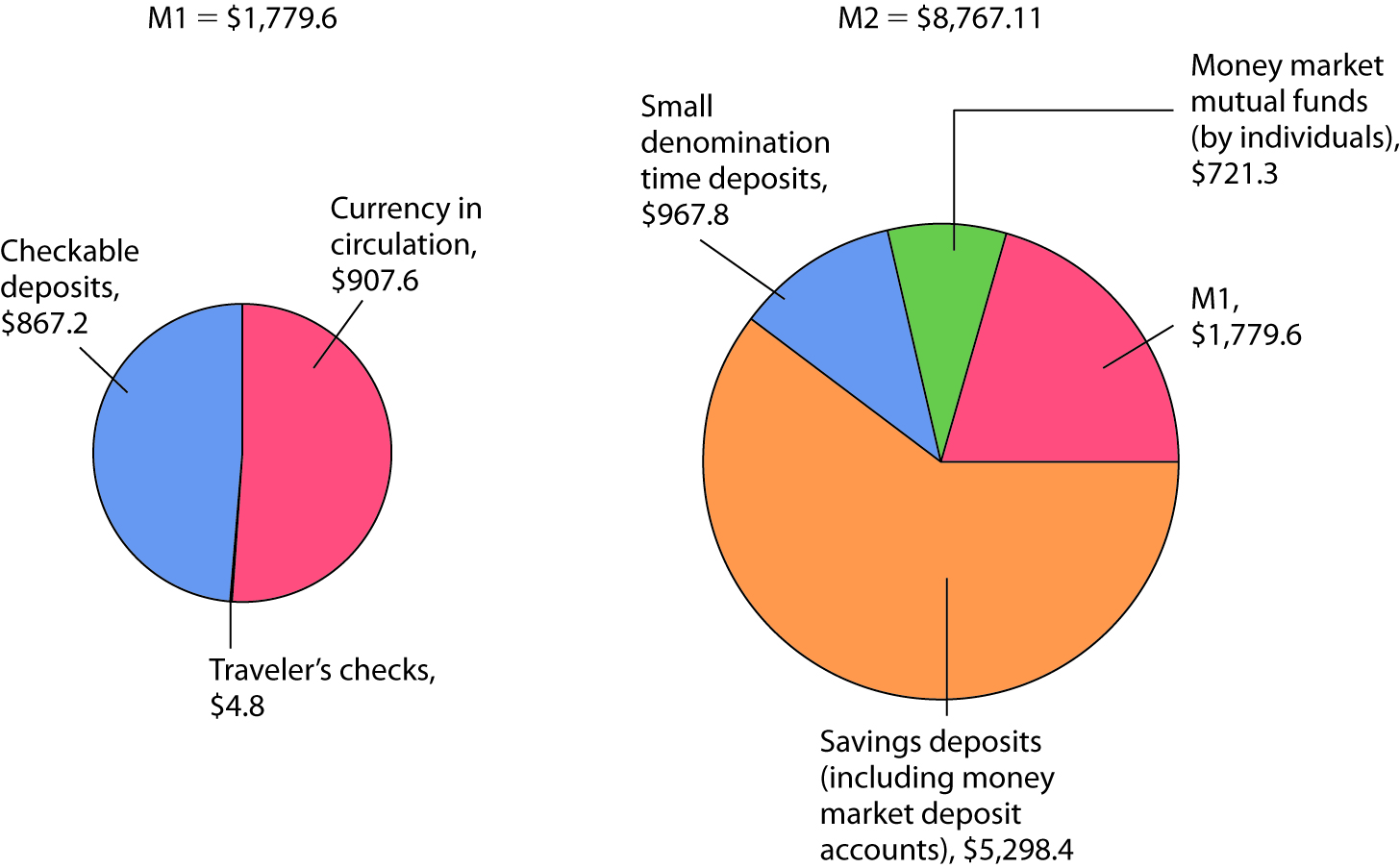
M1, the narrowest definition of the money supply, includes assets that are perfectly liquid. M2 provides a broader measure of the coin supply and includes somewhat less liquid assets. Amounts stand for money supply information in billions of dollars for October 2010, seasonally adjusted.
Source: Federal Reserve Statistical Release H.vi, Tables 3 and 4 (Dec two, 2010). Amounts are in billions of dollars for Oct 2010, seasonally adjusted.
Heads Up!
Credit cards are not coin. A credit carte du jour identifies you lot equally a person who has a special arrangement with the card issuer in which the issuer volition lend yous money and transfer the proceeds to some other party whenever you want. Thus, if you present a MasterCard to a jeweler every bit payment for a $500 ring, the business firm that issued y'all the bill of fare volition lend you lot the $500 and ship that money, less a service charge, to the jeweler. Yous, of form, will be required to repay the loan later. But a card that says yous have such a relationship is not money, but as your debit card is not money.
With all the operational definitions of money available, which one should we use? Economists more often than not respond that question by asking another: Which measure of coin is most closely related to real GDP and the price level? Every bit that changes, and so must the definition of money.
In 1980, the Fed decided that changes in the ways people were managing their money made M1 useless for policy choices. Indeed, the Fed now pays lilliputian attention to M2 either. Information technology has largely given upwardly tracking a detail measure of the money supply. The pick of what to measure as money remains the discipline of continuing research and considerable debate.
Key Takeaways
- Money is anything that serves as a medium of exchange. Other functions of money are to serve equally a unit of account and as a store of value.
- Coin may or may not accept intrinsic value. Commodity money has intrinsic value because information technology has other uses also existence a medium of substitution. Fiat coin serves only as a medium of exchange, because its apply as such is authorized by the government; it has no intrinsic value.
- The Fed reports several different measures of money, including M1 and M2.
Try It!
Which of the post-obit are money in the United States today and which are not? Explain your reasoning in terms of the functions of money.
- Aureate
- A Van Gogh painting
- A dime
Case in Bespeak: Fiat-less Money
"We don't accept a currency of our own," proclaimed Nerchivan Barzani, the Kurdish regional government's prime minister in a news interview in 2003. But, even without official recognition past the government, the so-called "Swiss" dinar certainly seemed to function as a fiat money. Hither is how the Kurdish area of northern Iraq, during the period between the Gulf War in 1991 and the fall of Saddam Hussein in 2003, came to have its own currency, despite the pronouncement of its prime minister to the contrary.
After the Gulf War, the northern, mostly Kurdish area of Republic of iraq was separated from the rest of Iraq though the enforcement of the no-wing-zone. Because of Un sanctions that barred the Saddam Hussein regime in the due south from continuing to import currency from Switzerland, the cardinal bank of Iraq announced it would replace the "Swiss" dinars, then named because they had been printed in Switzerland, with locally printed currency, which became known equally "Saddam" dinars. Iraqi citizens in southern Iraq were given three weeks to substitution their old dinars for the new ones. In the northern function of Republic of iraq, citizens could not exchange their notes and so they merely continued to utilise the old ones.
And and then it was that the "Swiss" dinar for a catamenia of about 10 years, even without authorities backing or whatever law establishing it as legal tender, served every bit northern Iraq's fiat money. Economists apply the word "fiat," which in Latin means "let it be done," to describe money that has no intrinsic value. Such forms of money usually get their value considering a authorities or authority has declared them to be legal tender, but, as this story shows, it does non actually require much "fiat" for a convenient, in-and-of-itself worthless, medium of exchange to evolve.
What happened to both the "Swiss" and "Saddam" dinars? Later on the Coalition Provisional Potency (CPA) causeless control of all of Iraq, Paul Bremer, then head of the CPA, announced that a new Iraqi dinar would exist exchanged for both of the existing currencies over a three-month period catastrophe in Jan 2004 at a charge per unit that implied that one "Swiss" dinar was valued at 150 "Saddam" dinars. Because Saddam Hussein'south regime had printed many more "Saddam" dinars over the x-year menstruum, while no "Swiss" dinars had been printed, and because the cheap press of the "Saddam" dinars made them easy to counterfeit, over the decade the "Swiss" dinars became relatively more valuable and the exchange rate that Bremer offered about equalized the purchasing power of the 2 currencies. For case, it took virtually 133 times as many "Saddam" dinars as "Swiss" dinars to buy a homo's conform in Republic of iraq at the time. The new notes, sometimes called "Bremer" dinars, were printed in United kingdom of great britain and northern ireland and elsewhere and flown into Republic of iraq on 22 flights using Boeing 747s and other big shipping. In both the northern and southern parts of Iraq, citizens turned in their old dinars for the new ones, suggesting at least more confidence at that moment in the "Bremer" dinar than in either the "Saddam" or "Swiss" dinars.
Sources: Mervyn A. King, "The Institutions of Monetary Policy" (lecture, American Economic science Association Annual Meeting, San Diego, Jan 4, 2004), available at http://www.bankofengland.co.u.k./speeches/speech208.pdf. Hal R. Varian, "Paper Currency Can Have Value without Government Backing, but Such Backing Adds Substantially to Its Value," New York Times, January 15, 2004, p. C2.
Answer to Effort It! Trouble
- Gold is not coin because it is non used as a medium of exchange. In improver, information technology does not serve as a unit of account. Information technology may, nonetheless, serve equally a store of value.
- A Van Gogh painting is not money. It serves as a store of value. It is highly illiquid but could somewhen be converted to money. It is neither a medium of exchange nor a unit of business relationship.
- A dime is money and serves all three functions of coin. It is, of course, perfectly liquid.
Source: https://open.lib.umn.edu/principleseconomics/chapter/24-1-what-is-money/
0 Response to "A Work of Art Is an Example of Money Because It Can Act as a Store of Value"
Post a Comment